
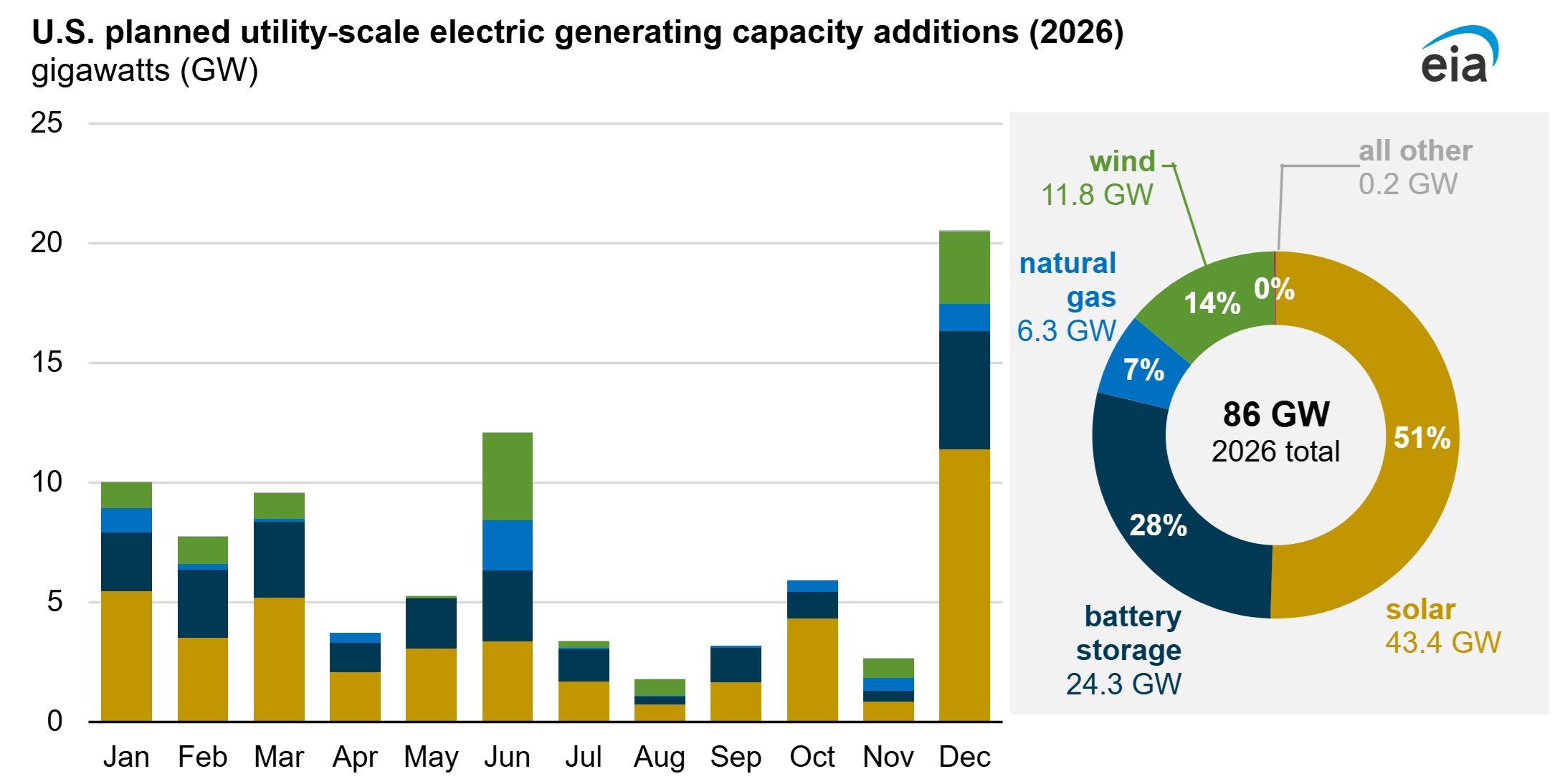
United States power plant developers and operators plan to add 86 gigawatts (GW) of new utility-scale electric generating capacity to the power grid in 2026 according to the Energy Information Association’s (EIA) latest Preliminary Monthly Electric Generator Inventory report — a record if realized.
Solar power makes up 51% of the planned 2026 capacity additions, followed by battery storage at 28% and wind at 14%.
In 2025, 53 GW of new capacity was added to the grid, the largest capacity installation in a single year since 2002.
Developers plan to add 43.4 GW of new utility-scale solar capacity in 2026, a 60% increase in capacity additions from last year if realized. More than half of the new utility-scale solar capacity is planned for four states: Texas (40%), Arizona (6%), California (6%) and Michigan (5%).
Developers plan to add 24 GW of utility-scale battery storage to the grid this year, compared with a record 15 GW added in 2025. U.S. battery storage capacity has grown exponentially over the last five years with more than 40 GW added to the grid during this period.
Annual U.S. wind capacity additions have slowed, following record additions of more than 14 GW in both 2020 and 2021. But wind capacity addition could rise in 2026 with 11.8 GW planned to be added to the grid, more than double the capacity added last year.
In 2026, developers plan to add 6.3 GW of new natural gas-fired capacity. Combined-cycle generation is expected to account for 3.3 GW of the planned additions, while combustion turbine units account for 2.8 GW.
 " data-object-fit="cover">
 " data-object-fit="cover">