
Great River Energy carefully tracks greenhouse gas emissions from the energy sources used to serve our member-owner cooperatives and customers. This tracking and reporting is important for gauging progress towards Minnesota’s renewable energy and greenhouse gas (GHG) reduction goals. Further, our members and their retail customers use it for their GHG tracking and reporting.
Great River Energy’s energy mix includes:
- Owned generation (peaking plants and Spiritwood Station)
- Market purchases [Midcontinent Independent System Operator (MISO)]
- Power purchase agreements (mostly wind)
- Financial hedges with Rainbow Energy (owner of the coal-based power plant sold by Great River Energy in 2022)
To calculate total greenhouse gas emissions (portfolio emissions) and carbon intensity, Great River Energy includes contributions from all these sources. We then divide total greenhouse gas emissions by energy obtained annually to serve our members and customers to calculate an annual emission intensity value. This carbon intensity, also known as emission rate, helps our member owners and their electric consumers estimate their carbon footprints. This carbon intensity value can be used to calculate ‘Scope 2 emissions’ for our members and their customers under the World Resource Institute (WRI) greenhouse gas protocol.
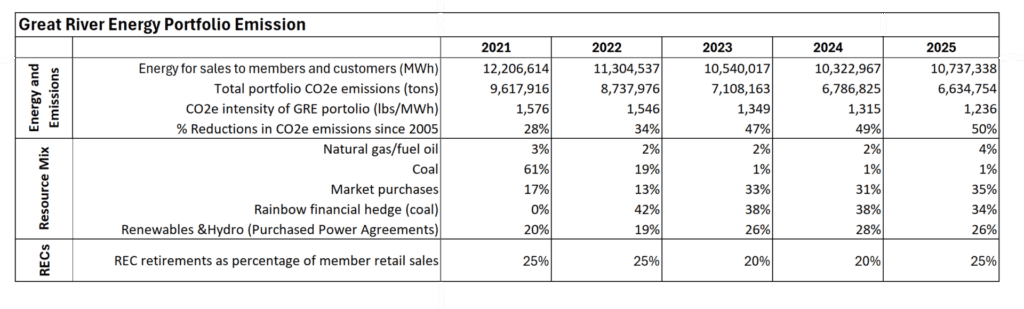
Key observations from these data.
- The drop in emissions from 2022 to 2023 is attributable to the sale of the coal-fired Coal Creek Station. During this year MISO market purchases increased to replace a portion of the energy from Coal Creek Station. This resulted in a significant reduction in emissions because energy from the market has a lower carbon intensity than Coal Creek Station.
- We track renewable energy certificate (REC) retirements in the context of the renewable energy standard. This standard requires the retirement of RECs for 20% of retail sales until 2025; this requirement increases to 25% in 2025 and then 55% in 2035.
- We also track the reduction in the emissions since 2005. These values are comparable to the goals for economy-wide reductions in emissions set by the Minnesota Next Generation Energy Act. The goals set by the act are a 50% reduction in state-wide emissions by 2030 and a net zero goal for 2050. Note that these reductions are not equivalent to the percentage of carbon free energy under Minnesota’s Carbon Free Standard. Great River Energy is waiting for Minnesota Public Utilities Commission guidance on how to track compliance with that standard.
- Finally, in the table, the resource mix information provides visibility into our evolving portfolio as it transitions over time.
Calculation methods and key notes
Calculation Methodology
Our approach to calculating greenhouse gas emissions aligns with:
- Minnesota Ratepayer Methodology: Developed by the Minnesota Department of Commerce. See section 8.1.1 of Great River Energy’s 2023-2027 Integrated Resource Plan
- Greenhouse Gas Framework: Created by the World Resources Institute.
Key Notes:
- Our approach to accounting for emissions associated with market purchases changed in 2026. A PUC order directed utilities to use MISO Local Resource Zones 1-7 when determining what proportion of energy purchased from the market qualifies as carbon-free1. To align with this framework, we updated our greenhouse gas accounting approach to use the carbon intensity of MISO Local Resource Zones 1-7. Previously we used the Midwest Reliability Organization West (MROW) as provided in the EPA eGRID database as the source of the market carbon intensity. This change was applied to all years. Data from 2024 is provided to illustrate the impact of this change. The 2024 carbon intensity from MISO Resource Zones 1-7 is 1,303 lb CO2e/MWh compared to the MRWO intensity of 927 lb CO2e/MWh. The net effect of this update is an increase of CO2e intensity of the GRE portfolio in 2024 from 1,235 lb CO2e/MWh to 1,303 lb CO2e/MWh.
- Energy obtained independently by member-owner cooperatives (e.g., member-specific renewable resources or contracts) is not accounted for in these calculations.
- Great River Energy’s accounting approach is likely to evolve with additional guidance from the Minnesota Public Utilities Commission (PUC) and other developments.
- On an annual basis, Great River Energy updates these values. During this update, newly available data and refinements to our calculations can result in small changes in previously published values.
- None of the values presented in these tables align with the Minnesota Carbon Free Standard. We are waiting for PUC guidance on how to track compliance with that standard.
[1] MPUC Order, Docket No. E-999/CI-23-151 (Sept. 16, 2025) at page 12.
Dated: August 2026